Climate trees and orchard restoration on the Forth & Clyde Canal
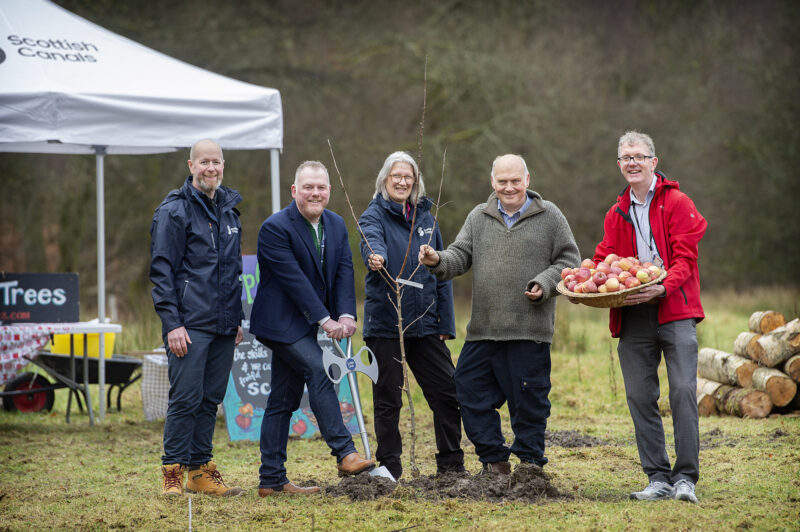
In 2026, Scottish Canals is working with Falkirk Council, Forth Climate Forest, Clyde Climate Forest and The Conservation Volunteers (TCV) to plant community orchards and stepping-stone woodlands (5m x 5m in area) along the Forth & Clyde Canal. At the same Scottish Canals is restoring gaps in historic hedgerows, which are rich sources of forage and shelter for urban wildlife, and many of which were originally planted by the early eighteenth-century canal builders.
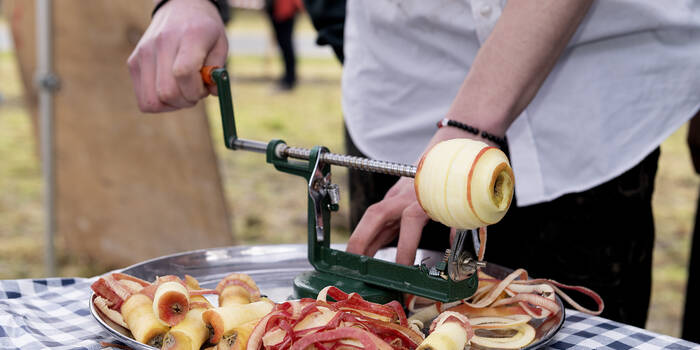
Since the 1850s, over 90% of Scotland’s historic orchards have been lost. Where orchards once existed near almost every village, often with their own unique fruit varieties, they are now a rarity. Scottish heritage varieties like Coul Blush, Bloody Ploughman, and Tarvey Codlin have come close to disappearing altogether.
Orchards are precious not just as places to grow fruit, they also provide habitat like no other: unlike dense woodland, their lighter canopies allow wildflowers and vegetation to thrive beneath them. This creates vital havens for insects, birds and small mammals – many of which have few suitable alternatives.
More widely, forests and ancient hedgerows have disappeared across many parts of the UK throughout the twentieth century. Those that still exist are often declining in terms of their biodiversity and quality. To help address this decline, Scottish Canals is working with a consortium of partner organisations to use spaces along the Forth & Clyde Canal for orchard creation, hedgerow restoration and planting of ‘climate forests’ and ‘stepping-stone woodlands”.
Climate forests work on the principle that woodland spaces provide significant urban cooling, assist in slowing surface water run-off, and act as effective carbon sinks. Stepping-stone woodlands refer to small areas of planting that work together to form corridors for wildlife migration and support recovery of endangered species.
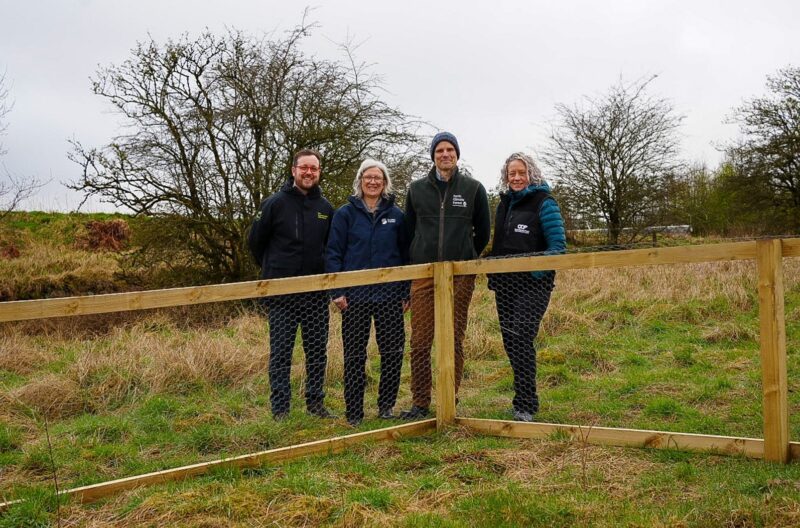
Laying the roots of Scotland’s first ‘sea-to-sea woodland corridor’
In 2026, Scottish Canals is working with Falkirk Council, Forth Climate Forest, Clyde Climate Forest, John Muir Way employability trainees, and The Conservation Volunteers (TCV) to plant community orchards and stepping-stone woodlands (5m x 5m in area) along the Forth & Clyde Canal. At the same Scottish Canals is restoring gaps in historic hedgerows, which are rich sources of forage and shelter for urban wildlife, and many of which were originally planted by the early eighteenth-century canal builders.
This is all part of a wider commitment by Scottish Canals to repurpose Scotland’s canals, lochs and reservoirs in ways that support climate change adaptation and mitigation. For Clyde Climate Forest and Forth Climate Forest, the project will contribute to their goal of planting almost 18 million new trees in across the Central belt and Stirlingshire.
2026 planting programme
This year, planting will take place at sites in:
- The grounds of the Falkirk Wheel
- Camelon (Falkirk)
- Dullatur (Cumbernauld)
- Auchinstarry (North Lanarkshire)
- Craigmarloch (Kilsyth)
- Wyndford (Glasgow)