
Lock 21 (Maryhill) Bypass Installation on the Forth & Clyde Canal
Location: Lock 21 (Maryhill Locks), Forth & Clyde Canal, Glasgow
Towpath Diversion: In place throughout the project
Duration: 23rd November to spring 2027
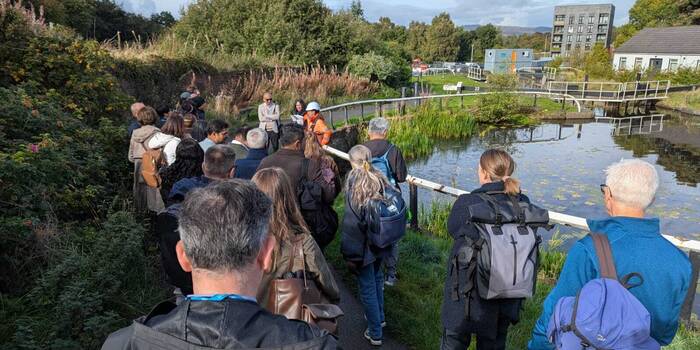
Scottish Canals continues to evolve the Glasgow Smart Canal – one of the first examples in the world of a canal being used as an urban sponge.
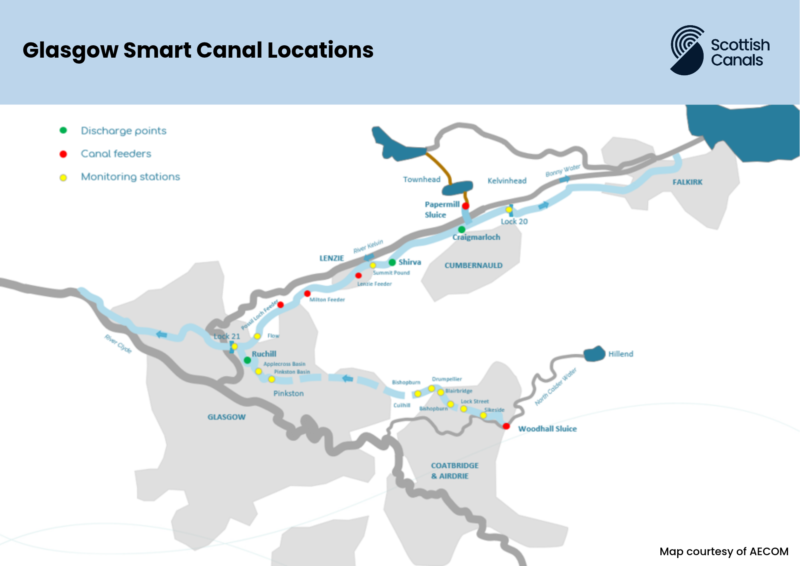
The Forth & Clyde Canal has the ability to lower its water level automatically in response to weather forecasts, providing capacity to soak up surface water run-off from canalside areas. When heavy rainfall is predicted, the canal can respond by lowering its levels by up to four inches over a 20-mile stretch of the canal in Glasgow.
The result is a canal that contributes to climate change mitigation in Scotland’s Central Belt. It has also freed up disused, brownfield sites for housing, which would otherwise have insufficient drainage, (3,500 new houses are built or in the pipeline as a result in North Glasgow).
How does the lock bypass at Maryhill fit in?
Installing bypasses at locks 20 and 21 is essential to ensuring that the canal can cope with additional incoming flows of water further downstream of the two locks when the smart canal is in operation (anticipating the upcoming housing developments along the canal).
A similar bypass was installed over the winter of 2024/2025 at Lock 20.
- Find more information about this earlier project
- Discover more about lock bypasses
The Lock 21 project is partially funded by Scottish Water (£630,000) and partially by Scottish Canal’s Capital Investment Fund, which is our funding from Scottish Government to maintain our canal infrastructure.
The lock bypass will give us better control over water levels in the canal, offering an alternative route for water around the lock. Meanwhile, we will install kiosks (small metal boxes) containing the telemetry technologies that enable the smart canal’s autonomy.
Works Timeline - November 2026 to Spring 2027
The construction phase of the project is set to commence from Monday 23rd November when the contractor will set up the site compound and begin fencing off the areas around the lock and putting in place diversion routes, including resurfacing of an existing pathway and access to a footbridge over Lock 23.
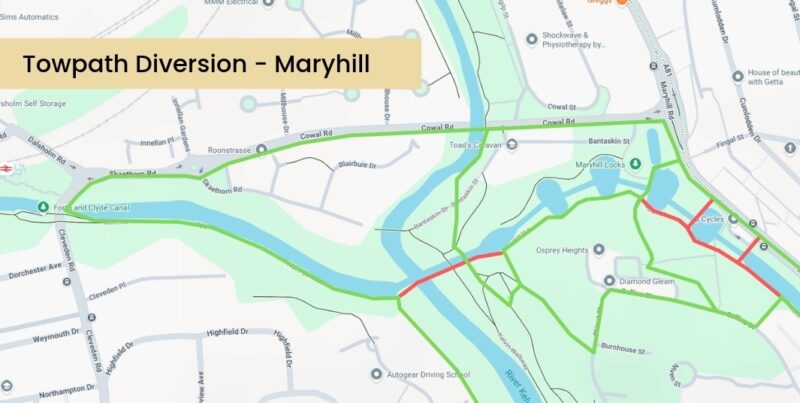
The below towpath diversion, around the works at the Kelvin Aqueduct (below left, in red) will be in place until mid-December, and the diversion around the bypass installation at Lock 21 (below right, in red)), will be in place until the end of the project in spring 2027.
Maryhill locks have high historical interest as well and we are working with Historic Environment Scotland (HES) to log archaeological finds throughout the works and ensure we safeguard important features of interest. We have also conducted ecology surveys to understand the presence of mammals in the area, as well as planning the fish screening that would be needed for the project.
If you have any questions or concerns, please contact us at enquiries@scottishcanals.co.uk or on 0141 332 6936 (Monday to Thursday 8.30am-5pm, Friday 8.30am - 4.30pm).