
Kelvin Aqueduct works unearth a hidden link to Glasgow’s secret wartime history
Over the centuries, Scotland’s canals have played some remarkable roles in times of war. From strengthening Britain’s maritime and inland defences to providing vital supply routes when seas were threatened by enemy vessels, these waterways have been called upon in times of national crisis.
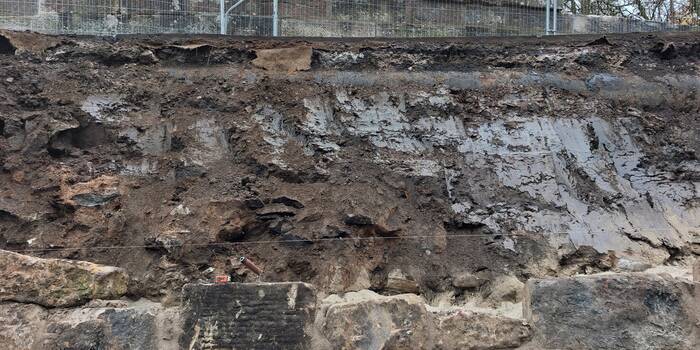
During the engineering works on the Kelvin Aqueduct in Maryhill, Glasgow, we have uncovered a fascinating remnant of that wartime history. It is a timely and moving reminder of the strategic role our canals have played, and of the impacts of the conflicts of the last century on the city.
Author: Chris O’Connell, Heritage Manager, Scottish Canals
The Caledonian Canal was, in many ways, born out of war. Conceived during the Napoleonic Wars, it was designed to provide a protected navigation route through Scotland’s Great Glen, allowing British naval vessels to avoid the exposed waters around the north of Scotland when travelling between the North Sea and the Atlantic.
By the time the canal opened in 1822, Napoleon had been defeated and had died in exile. Nevertheless, the strategic value of this sea-to-sea route endured.
The canal would eventually play a direct role in the country's wartime efforts. During the Second World War, it became an important part of Britain's defence and supply network, providing military vessels, submarines and fishing fleets with a protected inland route, away from the heavily patrolled North Sea.
The Forth & Clyde Canal, by contrast, was not conceived as a wartime asset. Constructed during the relatively peaceful years of the 1780s, its original purpose was commercial: transporting goods, passengers and, in particular, coal between Scotland's east and west coasts.
Throughout the nineteenth century, it carried a succession of commercial vessels, from the picturesque deep-hulled sailing ships of the 18th century to gabberts, puffers, steamers and tugs.
But the canal's strategic importance would eventually extend far beyond trade.
During the First World War, the Admiralty identified an opportunity to use the waterway to transport oil from the River Clyde on Scotland's west coast to the naval base at Rosyth on the east. This led to the construction of the Admiralty Pipeline, through which oil began flowing on 10 November 1918 – just one day before the Armistice brought fighting to an end.
It was a remarkable example of how Scotland's sea-to-sea canals could be adapted to meet the demands of national security, even if the pipeline came into operation rather late for that particular conflict.
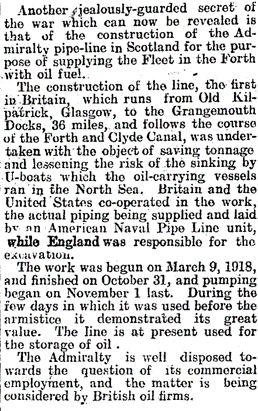
That brings us to today's engineering works on the Kelvin Aqueduct in Maryhill, where this remarkable piece of history has resurfaced.
The Admiralty Pipeline uncovered
We're currently undertaking a major repair project on the Kelvin Aqueduct, a 236-year-old structure that has carried the Forth & Clyde Canal over the River Kelvin since it opened in 1790.
This is the first time the aqueduct has been dewatered, as far as we know, given the scarcity of historical records. It may well be another 250 years before it is exposed in this way again, so certainly a sight worth seeing.
The works have already revealed some fascinating insights into the aqueduct's construction and its early operation. Among them is evidence of a wooden floor, used to protect the clay bed from the impact of deep-hulled sailing vessels navigating the canal in its early days.
Then, in early November, our contractor, Mackenzie Construction Ltd, uncovered a section of the Admiralty Pipeline itself.
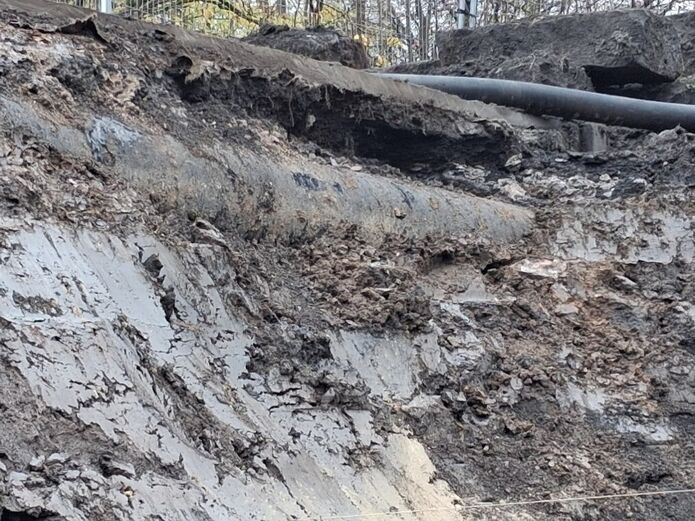
I visited the site recently with Senior Project Manager Denise Richmond and Graduate Apprentice Andrew Docherty, who captured the discovery on video.
The Forth & Clyde Canal in the Second World War
The pipeline was not the only military intervention along the Forth & Clyde Canal. Its wartime history continued into the Second World War, when the waterway and its surrounding communities found themselves much closer to the front line.
In March 1941, German bombers operating from their Norwegian airbases flew across north-east Scotland, gathering over Loch Lomond before heading down the Vale of Leven to attack the strategically important area of Clydebank.
Clydebank, which lies alongside the Forth & Clyde Canal, was a major target because of its munitions factories and shipbuilding industries, both vital to the Allied war effort. The raids of 13 and 14 March, involving hundreds of German bombers, left approximately 12,000 homes damaged, with thousands completely destroyed.
Nearby Greenock was also bombed in May 1941.
The threat of bombing also prompted defensive measures along the canal itself. The Forth & Clyde Canal Company constructed a series of emergency stop-locks, designed to restrict the flow of water into strategic sections of the waterway. Had the canal been breached by enemy bombs, these structures could have helped prevent uncontrolled flooding across large areas of north Glasgow.
Remnants of these wartime defences can still be seen along the canal today, including at Stockingfield Junction, Firhill Basin and Spiers Wharf.
From the Admiralty Pipeline of the First World War to the emergency stop-locks of the Second, these discoveries reveal a lesser-known side of Scotland's canals: not simply as routes for trade and transport, but as infrastructure that could be adapted to protect the nation in times of conflict.
They also offer a tangible connection to the people and events that shaped our history – and a reminder that even beneath the surface of our everyday landscapes, remarkable stories remain waiting to be uncovered.
Scottish Canals would be interested to hear from anyone who can share further stories about the canals and their role during wartime. Please contact enquiries@scottishcanals.co.uk, marked for the attention of Chris O’Connell.
Rewatering of the Falkirk Flight of the Forth & Clyde Canal
Over the past two years, Scottish Canals has been working with contractor Mackenzie Construction Ltd to deliver the biggest repair and upgrade programme on Scotland’s canals in 25 years. This project, on the Falkirk Flight of the Forth & Clyde Canal, is now entering its concluding stages.
£3.3 Million Investment to transform The Falkirk Wheel Visitor Centre
One of Scotland's top tourist attractions is investing in its future as improvements get underway at The Falkirk Wheel Visitor Centre.
Blue-Green Algae blooms
mIt is the season for blue green algae appearing on our canals and reservoirs. In some circumstances BGA can produce toxic substances that can pose a hazard to humans, pets and livestock.
Please report any sightings via the Bloomin’ Algae app which will be automatically shared with the Scottish Environment Protection Agency.