
Rewatering of the Falkirk Flight of the Forth & Clyde Canal
Over the past two years, Scottish Canals has been working with contractor Mackenzie Construction Ltd to deliver the biggest repair and upgrade programme on Scotland’s canals in 25 years. This project, on the Falkirk Flight of the Forth & Clyde Canal, is now entering its concluding stages.
What is the Falkirk Flight?
The Falkirk Flight is a stretch of the historic Forth & Clyde Canal, which first opened to navigation in 1790 and is recognised as the world’s first recorded sea-to-sea canal.
It forms part of the canal’s ‘East Reach’, which starts at the Sea Lock in Grangemouth and extends to the centre of Falkirk (Lock 16), before continuing towards The Falkirk Wheel, where the Forth & Clyde Canal connects to the Union Canal.
From this junction, the Forth & Clyde Canal continues westwards towards Glasgow. Its ‘West Reach’ extends to the harbour at Bowling on the Firth of Clyde.
Keeping the entire 56 km of the canal open to navigation, safe and accessible is a year-round task for our Operations and Maintenance teams, who manage water levels, water quality, towpaths and the wider canal estate.
At times, the canal, which is now more than 230 years old and a Scheduled Monument, needs more fundamental intervention. This is where our Engineering & Asset Team comes in. The team continually inspects the condition of the canal infrastructure and feeder reservoirs, initiating engineering works and repair programmes when needed.
The Falkirk Flight engineering works
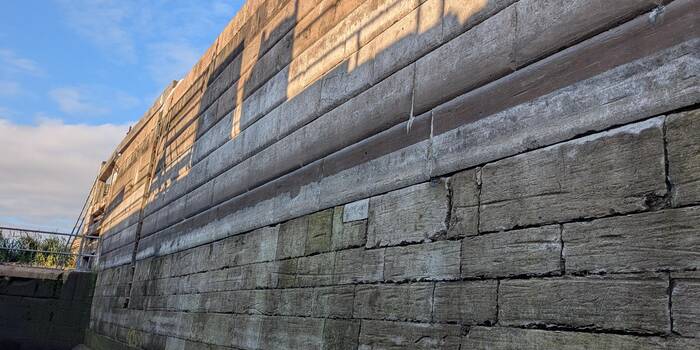
At the start of 2025, with many of the lock gates on the Falkirk Flight showing signs of deterioration, we launched a major gate replacement and repair programme. This also included associated repairs to embankments, masonry and lock mechanisms. At the same time, we installed a lock bypass at Lock 16 to improve future water management.
To enable the works, we had to dewater the Falkirk Flight between Locks 3 and 16, continuing to feed water downstream around the drained section using pumps and siphons.
Bringing the water back in
With the works nearing completion, we are now preparing to rewater most of the canal between locks 3 and 16.
Locks 4 and 13 will remain isolated using stop planks for the final gate replacements in February. Installing stop plank grooves along the lock flight was one of the improvements we made during the works: this will ensure that we can dam locks individually and that we will not need to dewater such a long stretch of canal again for any future maintenance works.
Rewatering the canal will require careful monitoring, including of:
- The embankments and canal bed for any signs of leakage.
- The natural environment and water quality, working around bird-nesting periods and ensuring aquatic life can safely return to the canal.
- Floating vegetation, refuse and debris emerging from the canal bed as water levels rise.
The process will be slow and gradual, with water introduced into each section of the Falkirk Flight in small increments. We will begin by rewatering the section from Lock 16 towards Lock 13. We will then assess progress in January before continuing to rewater the remaining sections towards Lock 3, keeping locks 4 and 13 isolated until their new gates are in place.
The process may also be paused at times to adjust the rate of water ingress and check for any signs of impact on the canal bed.
The rewatering process in five steps
- We have begun clearance of vegetation along the canal banks: this is to give our engineers a clear view of the embankments so that they can monitor them for any water leakage during the rewatering. Our contractor is also completing the final masonry grouting and installation of stop planks at the two remaining locks scheduled for repair.
- Next, we will start to release water through the new water-control bypass at Lock 16, initially filling the canal section up to Lock 15 before progressing down the Falkirk Flight.
- Where needed, our Operations Team will clear vegetation from the canal channel using a weed harvester. This is a kind of amphibious tractor that can operate in water to remove overgrowth, floating debris and refuse. At this stage, we can also bring submerged refuse to the surface and remove it safely from the channel.
- Once sufficient water levels have been achieved, the canal channel will no longer be classed as a construction site and the temporary fences will be removed, allowing us to reopen all of the towpaths and carry out any landscaping works needed to reinstate walking and cycling routes.
- When water levels are high enough, we will need to test the new gates and mechanisms to ensure they are fully operational before opening this stretch of the canal to navigation again. Other preparations will include clearance of silt from the sea lock.
We anticipate that the Falkirk Flight will be fully rewatered by March 2027, with the final gate replacements at locks 4 and 13 also completed by this time. Sea-to-sea navigation along the Forth & Clyde Canal is scheduled to resume on 23rd April 2027.
For further updates, please check our project page and social media channels.
You can also get in touch with us at enquiries@scottishcanals.co.uk or on 0141 332 6936 (lines are open Monday to Thursday, 8.30am-5pm, Friday 8.30am - 4.30pm). Visit Contact Us for our emergency and moorings customer contacts.
Blue-Green Algae blooms
mIt is the season for blue green algae appearing on our canals and reservoirs. In some circumstances BGA can produce toxic substances that can pose a hazard to humans, pets and livestock.
Please report any sightings via the Bloomin’ Algae app which will be automatically shared with the Scottish Environment Protection Agency.
Scottish Canals Parliamentary Reception, 1st October 2026
On Thursday 1st October, Scottish Canals held a reception at the Scottish Parliament to mark and celebrate the 25th anniversary of the Millennium Link project. This £83.5 million project reconnected Scotland's Lowland canals, rescuing them from dereliction and unlocking public value and benefits for generations to come.
Kelvin Aqueduct Repair Plan and Reopening Date Announced
Scottish Canals is conducting a major programme of investigation, design and repairs on the historic Kelvin Aqueduct in Maryhill, Glasgow, together with contractor Mackenzie Construction. Repair work has now begun and this section of the canal will reopen on 1st March 2027.