
Scottish Canals Technical Tour - IWA Water Congress & Exhibition 2026
A mammoth water industry conference wound up in Glasgow last week. From 4th to 8th October, the IWA World Water Congress & Exhibition brought together delegates from around the world to share knowledge and experience of working with water as a utility, managing waterways, and moving to more sustainable models of water management.
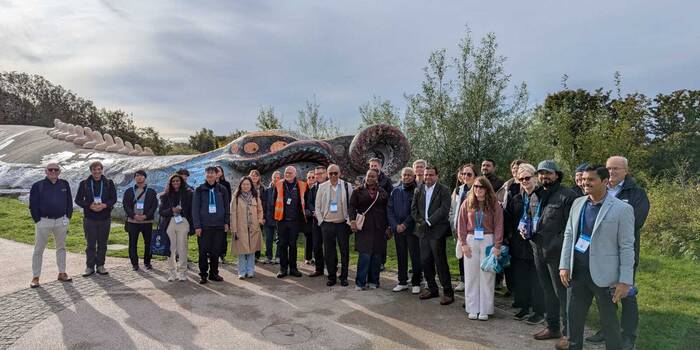
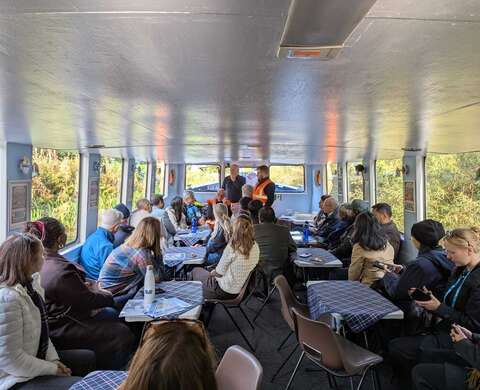
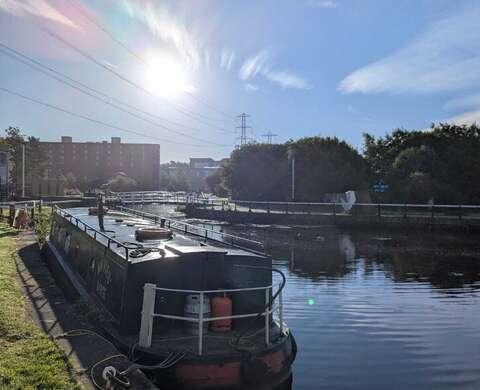
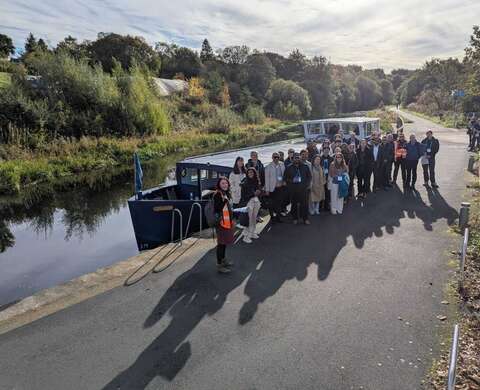
As part of the week’s schedule of technical tours, Scottish Canals invited a delegation of 30 industry experts to take a trip on the Forth & Clyde Canal Society's Voyager vessel. The group included people working on a wide variety of water projects, including canal projects in Nigeria, India, Europe and England.
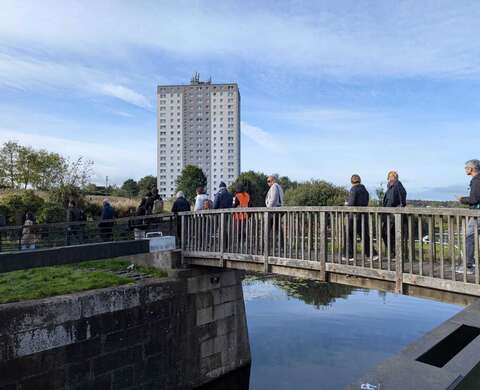
The journey took them from Applecross Wharf, in Glasgow, past the Hamiltonhill Claypits inner city nature reserve and the Smart Canal Sustainable Urban Drainage system, across Stockingfield Bridge, and up to the Kelvin Aqueduct, which is currently undergoing a major refit and restoration project.
Speakers represented core disciplines and expertise from across Scottish Canals.
Innovation
Ross Speirs, Deputy Director of Engineering & Assets, led the Smart Canal part of the technical tour as the Voyager progressed past the telemetry kiosks along Ruchill. Graduate Engineer Fraser Shaw, who is specialising in smart canal technologies, was also on hand to answer questions from delegates.
Key Points – Smart Canal
The Smart Canal is part of the North Glasgow Integrated Water Management System (NGIWMS) and is a partnership between Scottish Canals, Scottish Water and Glasgow City Council. The initiative was announced in 2018 as a European first and launched at COP26 in 2021. Since then, the evolution of both the technology and the system have picked up pace.
The system utilises the top 100mm of the summit pound of the Forth & Clyde Canal over a 32km stretch between locks 20 (Wyndford) and 21 (Maryhill) to absorb surface-water run-off from housing developments in the north of Glasgow. Without this additional drainage, these former brownfield, post-industrial sites would remain unused and derelict.
Overall, the Smart Canal has unlocked 110ha in north Glasgow for investment and regeneration, allowing for the construction of 3,500 houses – some now built, others in the development pipeline. The Smart Canal shows how urban canals address flood risks, ensures that brownfield land is properly utilised for the public good, supports housing provision in cities, and contributes to climate change adaptation.
The system is based upon a Digital Twin model, which covers the Summit Pound (between Locks 20 and 21), the Glasgow Branch of the Forth & Clyde Canal and the open channel and piped sections of the Monkland Canal. This allows for development and testing without affecting the canal system itself.
The Smart Canal model scans Met Office weather forecasts to:
- Estimate the impact of weather events on the Summit Pound and Glasgow Branch;
- Determine the need for dropping the canal’s water levels to absorb surface water runoff (up to 100mm 48 hours in advance of a weather event);
- Dynamically adjust its instructions to increase or decrease water levels as a weather event unfolds.
The Smart Canal is an intelligent model, but it is not an AI system. Its operational modes are:
- Manual, All abstraction and discharge sites are set by designated staff in Engineering & Assets, based on the data from the Met Office and the current canal position (taken from the monitoring sites in the model).
- Semi-autonomous. - the model interprets incoming forecasts and make a recommendation based on: 1) Previous weather events from the same period; 2) The current state of the canal water level; 3) The 'rules' inputted into the model by Scottish Canals and AECOM. Recommendations are sent to the control team who can activate the system accordingly or amend settings slightly before activation.
- Fully automated. The model reacts to incoming data from weather forecasts and adjusts the state of the canal automatically (as long as it is in a way that does not contradict the three points above). The control team can override the model at any time.
Engineering & Heritage
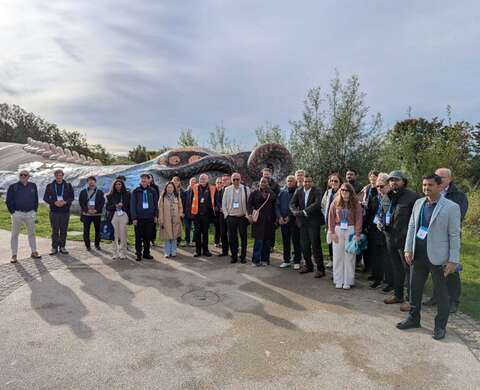
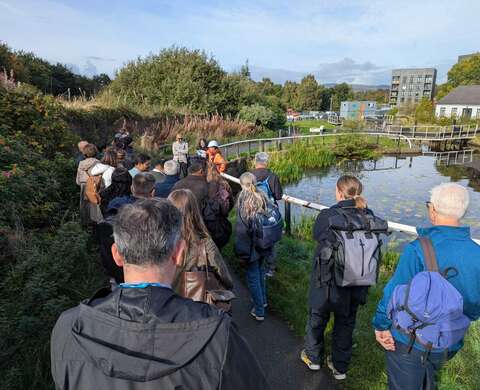
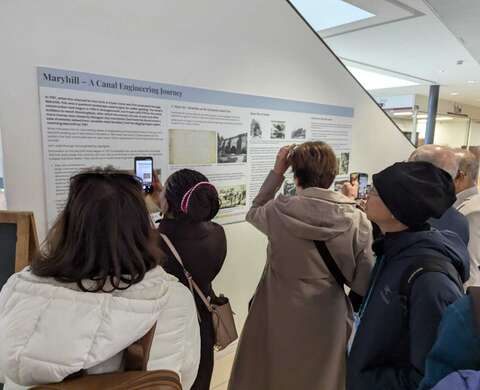
Delegates visited the current exhibition at Maryhill Burgh Halls Every Picture Tells A Story (which closed on 11th October). The exhibition, a partnership between the Halls and Scottish Canals, covered canal history and engineering along the Maryhill locks.
From the Halls it is a short walk to the Kelvin Aqueduct, which is currently dewatered and the subject of a major repair project being conducted in partnership with contractor Mackenzie Construction Ltd.
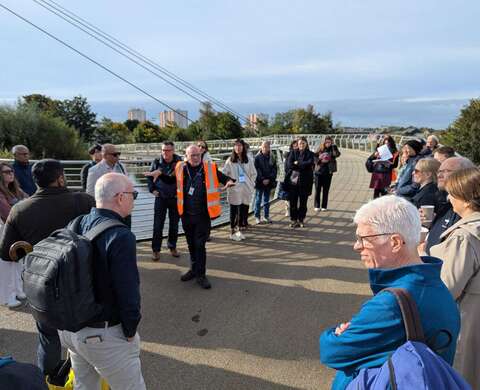
Chris O’Connell (Heritage Manager) and Denise Richmond (Senior Project Manager and the lead engineer on the project) provided the historic context and described the approaches they are taking to the structure’s repairs.
Key Points - The Kelvin Aqueduct Project
The aqueduct is a 236-year-old Scheduled Monument, and to the best of our knowledge, has never been dewatered before. The high quality of the engineering and construction means that the structure has served to carry the Forth & Clyde Canal over the River Kelvin since the day the canal opened in 1790.
While minor repairs have been implemented since its original construction, few records have come down to us; and indeed, few of the original plans for the aqueduct exist today. This means that the project has produced many learnings about the aqueduct’s construction and materials, now captured in a digital twin, investigation reports and a new maintenance schedule.
Matching the aqueduct's original materials has been crucial to ensuring the structure retains the same strengths and properties throughout. This includes sourcing lime mortar that closely matches the original and bringing in local masonry from a demolition site, Another aspect is preserving heritage features such as a newly discovered wooden shoring that protected the clay canal bed from 18th-century deep-hulled seafaring vessels.
The Kelvin Aqueduct is an example of how a sympathetic, thorough and responsive approach to engineering works is needed when working with heritage infrastructure. The lessons learnt from this aqueduct will be important for canal networks across the UK and across the world given that the Kelvin Aqueduct was a prototype for later canal aqueducts.
Environment
Dr Olivia Lassiere, Environment Manager, introduced delegates to the story of the reconnection of Scotland’s Lowland canals under the Millennium Link project 25 years ago (see our anniversary press release) and the ensuing environmental recovery of the waterways.
The Hamiltonhill Claypits inner city nature reserve served as an example of the industrial past and canal ecological recovery.
Key Points - Environmental Management and the Hamiltonhill Claypits Project
Scotland’s Lowland canals, built between 1790 and 1822 were heavily polluted legacy waterways by the mid-Twentieth Century, falling into dereliction and being closed to navigation by 1963.
The £83.5 million Millennium Link project marked the re-opening, revitalisation and ecological recovery of the canals, which are now thriving blue-green corridors running through our busiest towns and cities.
Pollutants present in the Forth & Clyde and Union canals originated from the heavy industries and chemical works that once lined their banks and included heavy metals, organic chemicals, untreated sewage and general dumping of waste. The Millennium Link project included a dredging programme to remove contaminated sediments and improve water quality.
The Forth & Clyde Canal is now rated ‘Good ecological status’ by SEPA (Scottish Environment Protection Agency) for its ecological potential, representing a radical transformation in the quality of its water and ecological value. Testament to this recovery is a thriving and diverse aquatic macrophyte and invertebrate community which in turn supports 21 species of freshwater fish in the Forth & Clyde Canal today, as well as a wide variety of birds including mute swans, moorhen, little grebes and kingfishers.
Located along the canal, close to Applecross Wharf, is the Hamiltonhill Claypits project which provides a perfect example of the social, economic and environmental benefits canal projects can bring.
The location, once the source of raw clay to waterproof the canal channels, was identified in 2008 as a ‘blight of vacant derelict land’. In response to requests from local residents for a wild park, a multi-agency funding partnership was initiated. This led to the 10ha derelict site being repurposed for public use and designated as a Local Nature Reserve in 2016, being fully opened to the public in 2021.
The site now demonstrates a clear nature positive outcome with a mix of habitats and a diverse flora and fauna. Bioblitzes have identified over 880 taxa on the reserve with species new to Scotland and other regionally notable insects.
Most importantly the award- winning Claypits project has connected communities and provided a quality environment to 13,000 households within a 10-minute walking distance of the site.
Historical find in the Kelvin Aqueduct intrigues canal historians
While work continues to investigate and repair a source of leakage from the Kelvin Aqueduct, we have found an intriguing structure at the base of the aqueduct trough...